


From Chatbot to Intelligent Agent: The Evolution of AI Customer Service in Europe and America
From Chatbot to Intelligent Agent: The Evolution of AI Customer Service in Europe and America
Click to downloadFeatured
No Image
ZENAVA's blockbuster release: Making AI the core productivity of customer service and marketing
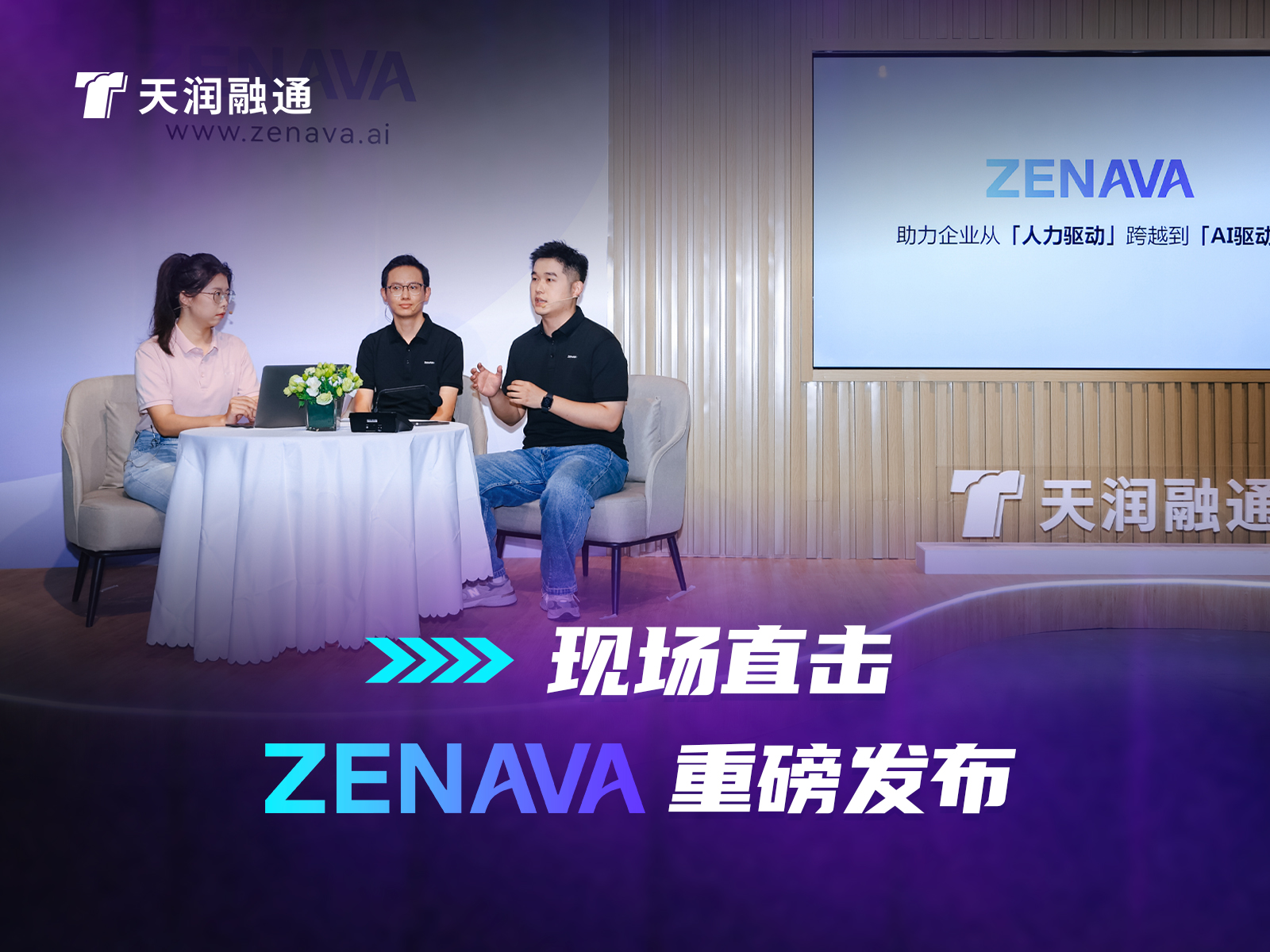
On September 17, the ZENAVA Product Launch Event was successfully held in Shanghai. Tianrun Rongtong officially unveiled ZENAVA, a conversational AI agent designed for service and marketing scenarios—driving AI to truly leap from a “tool” to a “role member,” helping enterprises reshape productivity and organizational structure, and enabling the transition from “people-driven” to “AI-driven” operations.AI-Driven Transformation of Productivity and Organizational StructureToday, enterprises widely recognize the value of AI. Yet many still face a hard-to-cross gap—from concept, to business implementation, to building real production capability.To bridge this gap, enterprises must grasp three key points: (1) identify the right entry point for AI deployment, (2) redesign existing business processes, and (3) reshape organizational structures. Only then can AI-driven production capability be formed.ZENAVA is designed exactly around this logic. By focusing on customer service and marketing scenarios, it helps enterprises rapidly build AI-driven production capacity.ZENAVA: A New-Generation Productivity PlatformHelping Enterprises Capture the AI Entry PointZENAVA is a new-generation productivity platform purpose-built for customer service and marketing. It aims to solve a common enterprise pain point: “AI looks capable, but results don’t land.” ZENAVA can not only communicate and execute, but also continuously learn and optimize—building an intelligent closed loop from conversation to action. It helps enterprises truly implement AI, convert it into production capability, and drive improvements in both efficiency and growth.Communicate: Talk Like a Real PersonPowered by Tianrun Rongtong’s scenario-based vertical model, ZENAVA can understand not only text, but also information in multiple forms such as images and videos. It supports complex multi-turn dialogue for information collection, with understanding and recognition accuracy exceeding GPT-4.1, while costing only 1/30 as much.In terms of interaction experience, ZENAVA uses persona modeling to enable language understanding and emotion perception. It can detect emotions from tone and phrasing, and respond in a friendly and respectful manner—balancing business boundaries with customer experience. It upholds the brand’s business bottom line while flexibly meeting customer needs.ZENAVA also delivers three major breakthroughs in voice interaction: human-like voice timbre, low-latency interaction, and precise intelligent interruption. It is no longer merely “able to speak,” but demonstrates a communication experience that surpasses human performance in both conversational behavior and expressiveness.These capabilities are embedded into its knowledge engineering, prompt templates, and scenario-based vertical model—making ZENAVA more than a “knowledge base + algorithm” combination. It is an AI employee with empathy, judgment, and high emotional intelligence, capable of maximizing value in real business scenarios.Execute: Complete the Business Loop IndependentlyZENAVA goes beyond natural conversation to directly drive business workflows—such as ticket creation and follow-ups—achieving a full closed loop of “understands, explains clearly, and gets it done.” This is a key differentiator from traditional text bots or voice bots.Like a human employee, ZENAVA can call tools to perform tasks such as sending SMS messages, creating work orders, retrieving customer profiles, and sending appointment notifications. It also builds a dual-memory mechanism across both business and user dimensions, recording and linking every business event to form traceable customer journeys and business status. This guides next actions and planning, turning dialogue into executable business operations.Get Productive Fast—and Keep Getting SmarterTo date, ZENAVA has accumulated 60 specialized sub-scenarios, 20,000+ common utterances, and 100,000+ similar variants, along with 100+ prebuilt agent workflow templates—enabling out-of-the-box use and rapid deployment. By continuously refining SOPs and best practices, ZENAVA ensures efficient rollout and reliable results. It also includes built-in coaching workflows: when it encounters issues, it can self-correct, generalize from cases, and become smarter with use.Multilingual Capability: Global Customer Communication CoverageZENAVA supports multilingual communication and can automatically detect and match the target language—allowing enterprises to serve customers across regions with a single agent. It currently supports Mandarin, English, Japanese, and Cantonese, and will continue expanding to more mainstream languages—helping enterprises deliver consistent and efficient customer communication in global operations.ZENAVA in Frontline Business: Creating Real ValueAt the launch event, Tianrun Rongtong showcased live demonstrations of ZENAVA in multiple scenarios:Smart Lock After-Sales TroubleshootingIn a smart lock troubleshooting scenario, ZENAVA acted like a professional diagnostics expert. Through multi-turn dialogue and accurate multimodal recognition with images, it independently completed fault diagnosis—from checking real-time video, to confirming the sentinel function, to firmware upgrades. With solid logic and easy-to-follow explanations, it significantly improved customer experience and issue-resolution efficiency.Footwear & Apparel After-Sales Damage AssessmentIn a complex damage assessment scenario for footwear and apparel, ZENAVA became a “business-savvy, intelligent negotiation specialist.” It collected multimodal information through multi-turn dialogue, intelligently identified damage types, provided defect review opinions, and flexibly applied communication strategies such as coupons or red packets—improving customer satisfaction while reducing enterprise losses.Auto Test-Drive Appointment BookingIn an auto test-drive invitation scenario, ZENAVA performed like a professional sales consultant. It quickly captured customer concerns, answered questions about configurations, pricing, and promotions, and recommended suitable stores based on the customer’s city. With a human-level conversation experience, it guided customers to complete test-drive reservations—effectively improving lead utilization efficiency and customer satisfaction.Home Appliance Installation Requests & Intelligent Follow-UpsAfter-sales service for home appliances often involves on-site installation appointments and repair requests. ZENAVA can automatically identify customer needs, generate work orders, and schedule on-site service. After completion, it can also conduct automated follow-ups to form a full business loop—greatly improving service efficiency and customer experience.Pre-Sales ReceptionZENAVA also performed strongly in pre-sales reception. It supports multilingual communication and can proactively collect key information to generate high-quality leads, improving conversion efficiency. After Tianrun Rongtong deployed ZENAVA on its domestic website for pre-sales inquiries and lead capture, the lead conversion rate increased from 45% to 66%.ZENAVA can also handle complex scenarios such as overseas hotel reservations. In Japanese, for example, it can independently execute the entire process—from understanding booking needs, confirming dates and room types, to completing the reservation.ZENAVA is now entering one real business scenario after another—becoming a tangible and measurable new form of productivity for enterprise customer service and marketing.Recently, the State Council issued the “Opinions on Deepening the Implementation of the ‘AI+’ Initiative,” which clearly states that by 2027, AI will be widely and deeply integrated into six key sectors ahead of schedule, with adoption rates of applications such as intelligent agents exceeding 70%; and by 2030, adoption rates of applications such as intelligent agents will exceed 90%.This points to a new direction for the industry: AI is no longer merely a tool for industrial upgrading, but infrastructure for China’s modernization and a core engine of new quality productive forces.This is ZENAVA’s mission and vision. Together with enterprises, ZENAVA will drive the transformation of productivity and organizational structure in customer service and marketing.
No Image
Customer Satisfaction Hits 84.6%! What Happens to Customer Service When Customers Start Saying “Thank You” to AI Agents?
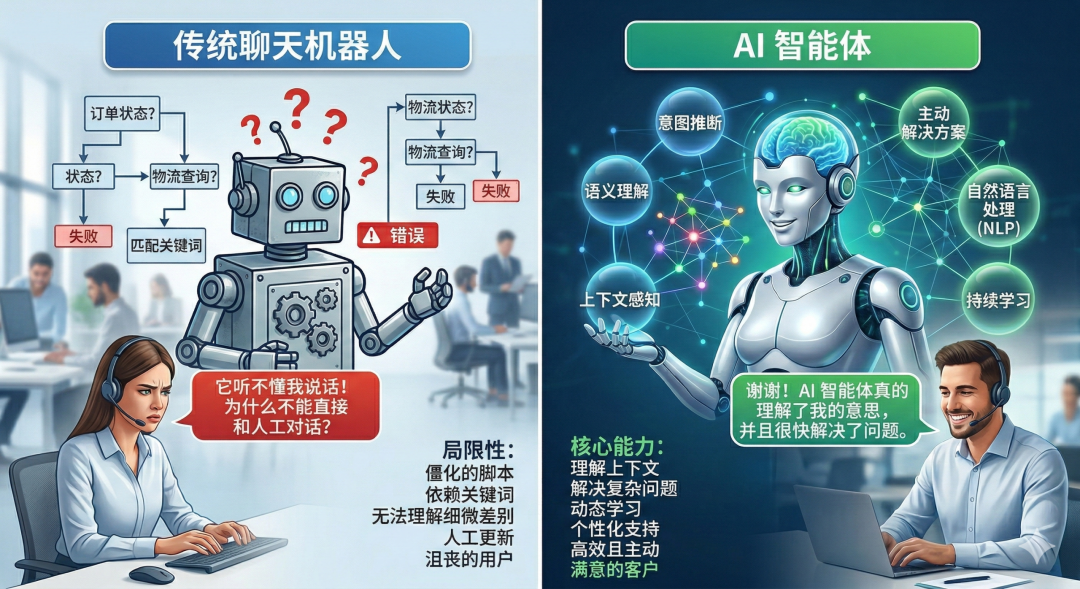
For a long time, conducting customer satisfaction surveys for customer service bots was something many companies found intimidating. In the common perception, customers were unlikely to be satisfied with bots that could only mechanically match keywords and were unable to handle complex situations.But today, with the adoption of Agents, that reality is beginning to reverse.Take one of the leading smart lock brands we serve as an example. The customer satisfaction rate of its Agent-powered customer service has already reached 84.6%. Even more telling is what has changed in real conversations: after their issues are resolved, more and more users now naturally say “thank you” to the bot.This shift — from “not daring to run satisfaction surveys” to “84.6% satisfaction,” and from “avoiding bots whenever possible” to “proactively expressing thanks” — reflects a fundamental upgrade in the service model.Agents have evolved into AI employees capable of independent thinking and autonomous execution. They no longer passively “answer questions”; they are now truly beginning to solve problems proactively, leading the customer service industry through a paradigm shift from traditional human-driven operations to AI-driven operations.The bot wasn’t unintelligent — the underlying logic was flawedFor years, traditional customer service bots were, at their core, little more than keyword-matching systems.To give such bots even basic service capabilities, companies often had to make heavy investments for limited returns. For example, building just 300 core knowledge points could require one employee to spend nearly three months manually entering thousands of similar question variations.Because the system relied so heavily on literal matching, even slightly more conversational wording — or a question phrased from a different angle — could cause the bot to fail, simply because it could not find the preset keywords.The arrival of Agents has fundamentally changed the way this service model works.First, Agents have moved from simple matching to intent reasoning. Instead of memorizing fixed question templates, they rely on the semantic understanding capabilities of large models to identify the user’s real intent directly.Agents no longer require teams to predefine complicated routing logic. No matter how tricky or ambiguous the question may be, they can dynamically retrieve relevant knowledge, organize the response, and deliver an accurate answer.This foundational upgrade becomes especially valuable in complex troubleshooting scenarios. For example, with one of the leading smart lock brands we serve, when faced with an urgent issue such as a tamper alarm, a traditional bot would typically do nothing more than push a long block of text instructions.An Agent, by contrast, can think more like an experienced employee. It may first ask, “Are you currently inside the door or outside?” and then guide the customer step by step based on the situation.This ability to guide users dynamically based on context and directly solve problems is precisely the core value unlocked by the upgrade in underlying technology.It’s not better at chatting — it’s better at solving problemsWhen the foundational logic evolves from “rote matching” to “logical understanding,” what companies gain is not simply a smarter chat tool, but a true AI employee that can drive a qualitative leap across efficiency, service boundaries, and cost structure.The first change is in how customer service work itself is organized, allowing each employee to create exponentially greater value.Under the Agent model, human agents no longer need to stay on the front line handling repetitive, low-value questions, nor do they need to spend large amounts of time manually maintaining massive numbers of similar question variants.Instead, human agents can become AI trainers. By reviewing Agent service outcomes, analyzing the causes of customer dissatisfaction, and retraining the Agent accordingly, companies can build a data-driven closed loop that fundamentally improves the speed and quality of service iteration.The second change is in service capability itself: things that could not be handled before can now be handled.Take troubleshooting as an example. The multimodal perception capabilities of large models have filled service blind spots that traditional bots could never reach. Today, users no longer need to describe every detail at length. They can simply send a photo, and the Agent can identify the key information hidden in the image and provide the appropriate guidance.For example, in electronics troubleshooting scenarios, an Agent can accurately identify from a photo that the user is using an Apple 20W charger, or recognize from a screenshot that the battery level is 0%. This direct understanding of real-world context makes troubleshooting — once heavily dependent on human intervention — dramatically more efficient.Finally, Agents are changing growth economics from “adding more people” to “adding more compute.”With Agents in place, business growth without headcount growth becomes a practical reality. Unlike traditional customer service staffing models, which expand and contract with business volume, Agents offer remarkable service stability. Our customer cases show that even when business volume doubles — growing by 120% — companies can maintain stable service quality without adding any customer service staff.The core reason is the deep automation of high-frequency yet complex scenarios. In resource-intensive service areas such as repair requests, Agents have achieved effective substitution of human labor through an independent handling rate of 60% and an ultra-fast response time of 1.8 to 2 seconds. Processes that once took human agents 5 to 10 minutes can now be transformed, through large-scale Agent deployment, into an operating model with far lower cost and far higher responsiveness.This is not an upgrade — it is a generational replacementWhen users begin voluntarily saying “thank you” to bots, this is no longer a matter of parameter optimization. It is a generational difference.Traditional customer service systems are, in essence, driven by the scale of human labor. Agent-based systems are driven by algorithmic efficiency. One scales by adding people; the other scales by redesigning the structure.In the former, marginal costs rise. In the latter, marginal costs decline.The real question companies need to consider is no longer whether they should adopt Agents, but whether they are prepared to rebuild their service systems around them. Because in the future, competition will not be about who has more people. It will be about whose Agents are more mature.If you are evaluating your Agent implementation path, or want to verify whether your scenario priorities are set correctly, we would be glad to help you break down your service structure together.
No Image
Conversation-as-a-Service, without redirection or repetition, ZENAVA makes customer service smarter
Today, as AI is rapidly permeating every industry, many enterprises have already deployed “intelligent customer service.” Yet customer feedback is often hard to describe: robotic tone, repeated questions, failure to understand real issues, and no smooth handoff to a human agent…“82% of users say they would rather wait in line for a human agent than talk to a cold, unhelpful bot.” This isn’t a joke—it’s the reality of many so-called intelligent customer service systems.Why does this happen? Because a lot of “AI customer service” is essentially just a talking FAQ. It can chat—but it can only chat.Recently, Tianrun Rongtong launched its conversational AI, ZENAVA, which is fundamentally changing that. ZENAVA doesn’t just “respond fluently”—it can also take action: it understands complex requests, automatically triggers operations, and makes “one sentence gets the service done” a reality.ZENAVA: Natural Interaction, Like Talking to a Real PersonTo understand what makes ZENAVA different, start with how it converses.Traditional AI conversations are like navigating a “menu.” You must hit the right keywords to enter the correct flow; otherwise, you fall into an endless loop of “Please say that again.” The moment your wording isn’t standardized, the system simply “doesn’t understand.”ZENAVA, however, truly understands natural language. Users don’t need to speak in rigid templates or perfect phrasing. They can describe the problem the way they’d talk to a friend, and the AI can identify intent, respond appropriately, sense emotion, and proactively ask for key details—bringing back the feel of real human interaction.For example, a traditional bot might ask:“Please select your issue type: 1) Order inquiry, 2) After-sales service, 3) Others.”With ZENAVA, you can simply say:“My smart lock won’t open—what should I do?”ZENAVA understands it’s an after-sales request and can immediately initiate diagnostics or dispatch a repair workflow.From “Can Talk” to “Can Do”: Closing the Service LoopIn the past, AI customer service could only “tell you what to do,” but could never take the final step: “Let me do it for you.”Take an internal IT support scenario. Previously, when an employee’s computer broke down, they had to contact IT, explain the situation, receive a ticket link, fill out a form, and submit it—complex and time-consuming.After integrating ZENAVA, the employee only needs to type one sentence—“My computer is broken. I need a repair request.”The AI can automatically generate the ticket and complete the follow-up workflow—simple and efficient.In an implementation at a global beverage giant, ZENAVA already handles a wide range of requests such as third-party account extensions, AVD account unlocks, VD password resets, and employee account renewals. In just 20 days after go-live, ZENAVA completed 1,625 business operations—an average of 81 issues solved per day—significantly improving internal service efficiency.Smart Lock Troubleshooting: AI Seamlessly Takes OverConsider after-sales troubleshooting for smart locks. Customers describe the on-site situation to support; technicians analyze the description, images, and other information to identify the root cause and provide a solution.Historically, this required heavy human involvement—partly because it relies on multiple types of information (images, voice, text), and partly because traditional voice bots sound too mechanical, making customers instantly recognize “this is a bot,” which drives up human handoff rates.With ZENAVA in place, the entire service process can be seamlessly handled by AI. Thanks to multimodal capabilities, ZENAVA understands text, recognizes voice and images, and communicates with customers through voice conversations that feel almost indistinguishable from a real person—making it difficult to tell whether it’s AI or human.In real deployments, ZENAVA can complete 2,000+ troubleshooting tasks per day, saving approximately 30% in labor costs—turning intelligence into real operational efficiency.A Shift in the Service ParadigmFrom customer service to internal support and beyond, more enterprises are handing their service entry points to conversational AI. This is not only about lower labor costs and higher efficiency—it represents a fundamental shift in how service works.Today, Tianrun Rongtong’s conversational AI product ZENAVA has already been adopted across multiple industries, including consumer electronics, retail chains, home & appliances, software services, and industrial equipment.When “conversation” becomes the new interface, it’s not just a bridge between people—it becomes the most natural connection between enterprises and customers, and between people and services. In the future, services will return to the simplest and most intuitive form: conversation.In this new era of “conversation as service,” ZENAVA is becoming a key force that connects enterprises with customers—helping more businesses achieve: one sentence to reach the right service, one conversation to resolve the issue.
BLOG
View MoreNo Image
ZENAVA's blockbuster release: Making AI the core productivity of customer service and marketing
On September 17, the ZENAVA Product Launch Event was successfully held in Shanghai. Tianrun Rongtong officially unveiled ZENAVA, a conversational AI agent designed for service and marketing scenarios—driving AI to truly leap from a “tool” to a “role member,” helping enterprises reshape productivity and organizational structure, and enabling the transition from “people-driven” to “AI-driven” operations.AI-Driven Transformation of Productivity and Organizational StructureToday, enterprises widely recognize the value of AI. Yet many still face a hard-to-cross gap—from concept, to business implementation, to building real production capability.To bridge this gap, enterprises must grasp three key points: (1) identify the right entry point for AI deployment, (2) redesign existing business processes, and (3) reshape organizational structures. Only then can AI-driven production capability be formed.ZENAVA is designed exactly around this logic. By focusing on customer service and marketing scenarios, it helps enterprises rapidly build AI-driven production capacity.ZENAVA: A New-Generation Productivity PlatformHelping Enterprises Capture the AI Entry PointZENAVA is a new-generation productivity platform purpose-built for customer service and marketing. It aims to solve a common enterprise pain point: “AI looks capable, but results don’t land.” ZENAVA can not only communicate and execute, but also continuously learn and optimize—building an intelligent closed loop from conversation to action. It helps enterprises truly implement AI, convert it into production capability, and drive improvements in both efficiency and growth.Communicate: Talk Like a Real PersonPowered by Tianrun Rongtong’s scenario-based vertical model, ZENAVA can understand not only text, but also information in multiple forms such as images and videos. It supports complex multi-turn dialogue for information collection, with understanding and recognition accuracy exceeding GPT-4.1, while costing only 1/30 as much.In terms of interaction experience, ZENAVA uses persona modeling to enable language understanding and emotion perception. It can detect emotions from tone and phrasing, and respond in a friendly and respectful manner—balancing business boundaries with customer experience. It upholds the brand’s business bottom line while flexibly meeting customer needs.ZENAVA also delivers three major breakthroughs in voice interaction: human-like voice timbre, low-latency interaction, and precise intelligent interruption. It is no longer merely “able to speak,” but demonstrates a communication experience that surpasses human performance in both conversational behavior and expressiveness.These capabilities are embedded into its knowledge engineering, prompt templates, and scenario-based vertical model—making ZENAVA more than a “knowledge base + algorithm” combination. It is an AI employee with empathy, judgment, and high emotional intelligence, capable of maximizing value in real business scenarios.Execute: Complete the Business Loop IndependentlyZENAVA goes beyond natural conversation to directly drive business workflows—such as ticket creation and follow-ups—achieving a full closed loop of “understands, explains clearly, and gets it done.” This is a key differentiator from traditional text bots or voice bots.Like a human employee, ZENAVA can call tools to perform tasks such as sending SMS messages, creating work orders, retrieving customer profiles, and sending appointment notifications. It also builds a dual-memory mechanism across both business and user dimensions, recording and linking every business event to form traceable customer journeys and business status. This guides next actions and planning, turning dialogue into executable business operations.Get Productive Fast—and Keep Getting SmarterTo date, ZENAVA has accumulated 60 specialized sub-scenarios, 20,000+ common utterances, and 100,000+ similar variants, along with 100+ prebuilt agent workflow templates—enabling out-of-the-box use and rapid deployment. By continuously refining SOPs and best practices, ZENAVA ensures efficient rollout and reliable results. It also includes built-in coaching workflows: when it encounters issues, it can self-correct, generalize from cases, and become smarter with use.Multilingual Capability: Global Customer Communication CoverageZENAVA supports multilingual communication and can automatically detect and match the target language—allowing enterprises to serve customers across regions with a single agent. It currently supports Mandarin, English, Japanese, and Cantonese, and will continue expanding to more mainstream languages—helping enterprises deliver consistent and efficient customer communication in global operations.ZENAVA in Frontline Business: Creating Real ValueAt the launch event, Tianrun Rongtong showcased live demonstrations of ZENAVA in multiple scenarios:Smart Lock After-Sales TroubleshootingIn a smart lock troubleshooting scenario, ZENAVA acted like a professional diagnostics expert. Through multi-turn dialogue and accurate multimodal recognition with images, it independently completed fault diagnosis—from checking real-time video, to confirming the sentinel function, to firmware upgrades. With solid logic and easy-to-follow explanations, it significantly improved customer experience and issue-resolution efficiency.Footwear & Apparel After-Sales Damage AssessmentIn a complex damage assessment scenario for footwear and apparel, ZENAVA became a “business-savvy, intelligent negotiation specialist.” It collected multimodal information through multi-turn dialogue, intelligently identified damage types, provided defect review opinions, and flexibly applied communication strategies such as coupons or red packets—improving customer satisfaction while reducing enterprise losses.Auto Test-Drive Appointment BookingIn an auto test-drive invitation scenario, ZENAVA performed like a professional sales consultant. It quickly captured customer concerns, answered questions about configurations, pricing, and promotions, and recommended suitable stores based on the customer’s city. With a human-level conversation experience, it guided customers to complete test-drive reservations—effectively improving lead utilization efficiency and customer satisfaction.Home Appliance Installation Requests & Intelligent Follow-UpsAfter-sales service for home appliances often involves on-site installation appointments and repair requests. ZENAVA can automatically identify customer needs, generate work orders, and schedule on-site service. After completion, it can also conduct automated follow-ups to form a full business loop—greatly improving service efficiency and customer experience.Pre-Sales ReceptionZENAVA also performed strongly in pre-sales reception. It supports multilingual communication and can proactively collect key information to generate high-quality leads, improving conversion efficiency. After Tianrun Rongtong deployed ZENAVA on its domestic website for pre-sales inquiries and lead capture, the lead conversion rate increased from 45% to 66%.ZENAVA can also handle complex scenarios such as overseas hotel reservations. In Japanese, for example, it can independently execute the entire process—from understanding booking needs, confirming dates and room types, to completing the reservation.ZENAVA is now entering one real business scenario after another—becoming a tangible and measurable new form of productivity for enterprise customer service and marketing.Recently, the State Council issued the “Opinions on Deepening the Implementation of the ‘AI+’ Initiative,” which clearly states that by 2027, AI will be widely and deeply integrated into six key sectors ahead of schedule, with adoption rates of applications such as intelligent agents exceeding 70%; and by 2030, adoption rates of applications such as intelligent agents will exceed 90%.This points to a new direction for the industry: AI is no longer merely a tool for industrial upgrading, but infrastructure for China’s modernization and a core engine of new quality productive forces.This is ZENAVA’s mission and vision. Together with enterprises, ZENAVA will drive the transformation of productivity and organizational structure in customer service and marketing.
No Image
Customer Satisfaction Hits 84.6%! What Happens to Customer Service When Customers Start Saying “Thank You” to AI Agents?
For a long time, conducting customer satisfaction surveys for customer service bots was something many companies found intimidating. In the common perception, customers were unlikely to be satisfied with bots that could only mechanically match keywords and were unable to handle complex situations.But today, with the adoption of Agents, that reality is beginning to reverse.Take one of the leading smart lock brands we serve as an example. The customer satisfaction rate of its Agent-powered customer service has already reached 84.6%. Even more telling is what has changed in real conversations: after their issues are resolved, more and more users now naturally say “thank you” to the bot.This shift — from “not daring to run satisfaction surveys” to “84.6% satisfaction,” and from “avoiding bots whenever possible” to “proactively expressing thanks” — reflects a fundamental upgrade in the service model.Agents have evolved into AI employees capable of independent thinking and autonomous execution. They no longer passively “answer questions”; they are now truly beginning to solve problems proactively, leading the customer service industry through a paradigm shift from traditional human-driven operations to AI-driven operations.The bot wasn’t unintelligent — the underlying logic was flawedFor years, traditional customer service bots were, at their core, little more than keyword-matching systems.To give such bots even basic service capabilities, companies often had to make heavy investments for limited returns. For example, building just 300 core knowledge points could require one employee to spend nearly three months manually entering thousands of similar question variations.Because the system relied so heavily on literal matching, even slightly more conversational wording — or a question phrased from a different angle — could cause the bot to fail, simply because it could not find the preset keywords.The arrival of Agents has fundamentally changed the way this service model works.First, Agents have moved from simple matching to intent reasoning. Instead of memorizing fixed question templates, they rely on the semantic understanding capabilities of large models to identify the user’s real intent directly.Agents no longer require teams to predefine complicated routing logic. No matter how tricky or ambiguous the question may be, they can dynamically retrieve relevant knowledge, organize the response, and deliver an accurate answer.This foundational upgrade becomes especially valuable in complex troubleshooting scenarios. For example, with one of the leading smart lock brands we serve, when faced with an urgent issue such as a tamper alarm, a traditional bot would typically do nothing more than push a long block of text instructions.An Agent, by contrast, can think more like an experienced employee. It may first ask, “Are you currently inside the door or outside?” and then guide the customer step by step based on the situation.This ability to guide users dynamically based on context and directly solve problems is precisely the core value unlocked by the upgrade in underlying technology.It’s not better at chatting — it’s better at solving problemsWhen the foundational logic evolves from “rote matching” to “logical understanding,” what companies gain is not simply a smarter chat tool, but a true AI employee that can drive a qualitative leap across efficiency, service boundaries, and cost structure.The first change is in how customer service work itself is organized, allowing each employee to create exponentially greater value.Under the Agent model, human agents no longer need to stay on the front line handling repetitive, low-value questions, nor do they need to spend large amounts of time manually maintaining massive numbers of similar question variants.Instead, human agents can become AI trainers. By reviewing Agent service outcomes, analyzing the causes of customer dissatisfaction, and retraining the Agent accordingly, companies can build a data-driven closed loop that fundamentally improves the speed and quality of service iteration.The second change is in service capability itself: things that could not be handled before can now be handled.Take troubleshooting as an example. The multimodal perception capabilities of large models have filled service blind spots that traditional bots could never reach. Today, users no longer need to describe every detail at length. They can simply send a photo, and the Agent can identify the key information hidden in the image and provide the appropriate guidance.For example, in electronics troubleshooting scenarios, an Agent can accurately identify from a photo that the user is using an Apple 20W charger, or recognize from a screenshot that the battery level is 0%. This direct understanding of real-world context makes troubleshooting — once heavily dependent on human intervention — dramatically more efficient.Finally, Agents are changing growth economics from “adding more people” to “adding more compute.”With Agents in place, business growth without headcount growth becomes a practical reality. Unlike traditional customer service staffing models, which expand and contract with business volume, Agents offer remarkable service stability. Our customer cases show that even when business volume doubles — growing by 120% — companies can maintain stable service quality without adding any customer service staff.The core reason is the deep automation of high-frequency yet complex scenarios. In resource-intensive service areas such as repair requests, Agents have achieved effective substitution of human labor through an independent handling rate of 60% and an ultra-fast response time of 1.8 to 2 seconds. Processes that once took human agents 5 to 10 minutes can now be transformed, through large-scale Agent deployment, into an operating model with far lower cost and far higher responsiveness.This is not an upgrade — it is a generational replacementWhen users begin voluntarily saying “thank you” to bots, this is no longer a matter of parameter optimization. It is a generational difference.Traditional customer service systems are, in essence, driven by the scale of human labor. Agent-based systems are driven by algorithmic efficiency. One scales by adding people; the other scales by redesigning the structure.In the former, marginal costs rise. In the latter, marginal costs decline.The real question companies need to consider is no longer whether they should adopt Agents, but whether they are prepared to rebuild their service systems around them. Because in the future, competition will not be about who has more people. It will be about whose Agents are more mature.If you are evaluating your Agent implementation path, or want to verify whether your scenario priorities are set correctly, we would be glad to help you break down your service structure together.

No Image
2026 Tianrun Rongtong Spring Festival Service Notice
Dear Tianrun Rongtong Customer,As the Spring Festival approaches, we welcome a season of renewal. At this joyful time of bidding farewell to the old and welcoming the new, all of us at Tianrun Rongtong extend our warmest greetings and best wishes to you.Thank you for your continued trust and support. Your recognition is a constant source of motivation for us. We strive for excellence and are committed to delivering service with warmth and value in every interaction.During the Spring Festival holiday, to ensure your needs are responded to promptly, we have arranged holiday on-duty support. If you need any assistance at any time, please call the hotlines below—we will be happy to help:Pre-sales Hotline: 1010-9099Service Hours: 10:00–18:00After-sales Hotline: 400-686-9009Service Hours: 24/7Thank you again for your trust and support!In the new year, we will continue to provide even better service to support the growth of your business.Wishing you a happy Spring Festival and a wonderful Year of the Horse!
White Paper
View More
PRODUCT
View MoreVIDEO
View More
Ushering a New Chapter in Intelligent Conversations
Let Zenava AI empower your enterprise to intelligently upgrade customer conversation scenarios